A lower level takes water from several directions: up through a floor drain, over the rim of a sump pit, down from a split pipe or an appliance, or in through a window well during heavy rain. Finding the source comes first, because it decides the category of water.
Lower-level water
Basement Water Damage in Lake Elmo, MN
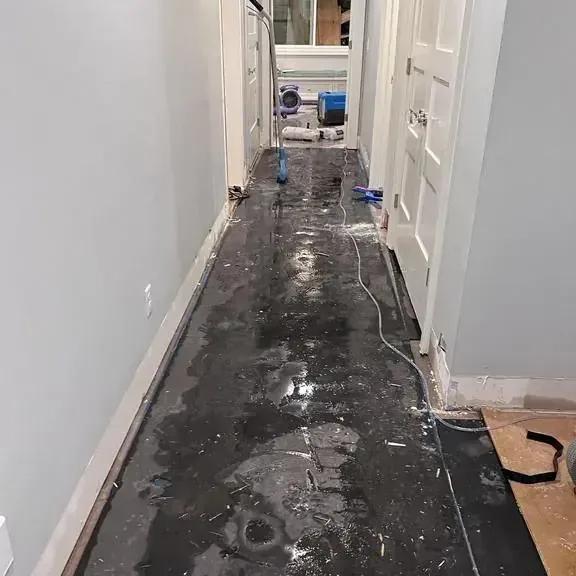
The mitigation team removes water from lower-level floors, cuts open wet wall bottoms, pulls soaked carpet and pad off the concrete, and dries the studs and slab until readings reach a dry reference.
(888) 432-4933Report water pooling on the lower-level floor Flood cuts when needed LGR slab drying Daily readings
Why it works
Why the dry-out is measured, not guessed
Dispatch at any hour
The response team runs 24/7, and active water is treated as urgent on nights, weekends and holidays.
IICRC S500 drying standard
Moisture mapping comes first, then air movers and LGR dehumidifiers sized to the class of loss.
A claim file built as it happens
Timestamped photos before demolition, a moisture map and daily psychrometric logs go to the adjuster.
Built for cold-climate homes
Basements, sump pits, frozen pipes and ice dams lead the local list, so checks start below grade and at the eaves.
Do this first
What to do first for basement water damage
Safe steps for the household while the response team is on the way.
- 1
Trace where it entered. Look at the floor drain, the pump pit and the tank first.
- 2
Shut the water off. Close the main if a pipe or fixture let go.
- 3
Make the room safe. Turn off breakers feeding outlets near the water.
- 4
Lift and photograph. Get boxes off the floor and shoot the high-water mark.
Cost and insurance
What does basement water damage cost in Lake Elmo, MN?
Expect roughly $1,500 to $4,000 for an unfinished area, $4,000 to $9,000 for a finished lower level that needs flood cuts, and $9,000 to $20,000 when contaminated water reaches every room.
Unfinished lower level
$1,500 to $4,000
- Water off bare concrete
- Belongings moved
- Slab dried
Finished lower level
$4,000 to $9,000
- Wet carpet and pad out
- Wall bottoms opened
- Cavities dried
Contaminated, every room
$9,000 to $20,000
- Category 2 or 3 cleanup
- Insulation removed
- Antimicrobial applied
Ranges are typical, not a quote: category of water, square footage, material class and how fast drying started move the number most. Run the water damage cost calculator for a closer range, and check your own policy for what it covers.
How it works
How basement water damage is handled, step by step
1
Survey
Thermal camera and meters locate wet bays.
2
Remove water
Concrete and carpet extracted dry.
3
Open up
Wet pad out, flood cuts where needed.
4
Dry and log
LGR drying with daily readings.
The full picture
Basement Water Damage, explained
Septic, sewer or supply pipe: the source sets the category
- A split supply pipe or a failed water heater starts as clean Category 1 water
- Sump overflow and appliance drain water are handled as Category 2
- A backup from a home septic system or a sewer connection is Category 3
Older parts of the city are largely on private septic while the newer western neighborhoods are on municipal sewer, so the crew asks which one serves the house.
Runoff after heavy rain
Ditches, culverts, ponds and storm sewers carry runoff here. When a heavy storm fills them, water can reach window wells and foundation cracks, and that runoff is cleaned up as Category 3.
Drying the concrete and framing
Carpet over concrete and framed walls trap water against the slab. Thermal imaging finds the wet bays, flood cuts open them, and LGR dehumidifiers run until the slab and bottom plates read dry.
Service area
Basement water damage across Lake Elmo and nearby communities
The drying team covers the whole city, from the Old Village District and established subdivisions like Savona and Foxfire to NorthStar, Cimarron Park and the homes around the Tri-Lakes.
The same service nearby: basement water damage in Stillwater, Oakdale, Mahtomedi.
Water still moving? (888) 432-4933
FAQ
Basement Water Damage questions in Lake Elmo, MN
Still wet right now?
Lower level taking on water? The mitigation team works below grade any hour of the day.
(888) 432-4933 (888) 432-4933Ask how the lower level gets driedWhat causes basement water damage in homes here?
Drain backups from a septic system or a sewer connection, sump pump failures in heavy rain, split pipes after a freeze and failed water heaters lead the list. Each sets a different cleanup.
Does basement water damage on septic get handled differently?
The house cleanup follows the same Category 3 rules: protective gear, removal of porous materials and an antimicrobial. A septic contractor checks the tank and drain field separately.
Does basement water damage always mean removing drywall?
Not in every case. Clean-water drywall that dries quickly can usually stay put. Flood cuts happen when readings show a wet cavity or the water was dirty; see structural drying for how the cavity is dried.
How long does basement water damage take to dry?
Plan on four to seven days for most finished lower levels. Thick concrete and wet insulation stretch that out, and nothing gets unplugged until the meters reach the dry reference.
Is basement water damage covered by insurance?
A sudden burst pipe or tank failure is often covered. A backup, runoff or a dead sump pump often falls under an add-on endorsement or a flood policy, so check your own declarations.
24/7 emergency dispatch
Wet lower level? Get the slab and walls dried.
Water held under carpet and inside framed walls keeps doing damage. The mitigation team opens what is wet and dries the slab and studs to a reading.
(888) 432-4933Line up the lower-level dry-out
Stillwater Water Damage Restoration
Stillwater, MN
(888) 432-4933
Open 24 / 7 / 365
Find us on Google