Drying a house is not drying the air in it. Wood, drywall, plaster and concrete hold water inside them, and the job is done only when those materials read the same as the dry parts of the house.
Measured drying
Structural Drying and Dehumidification in Stillwater, MN
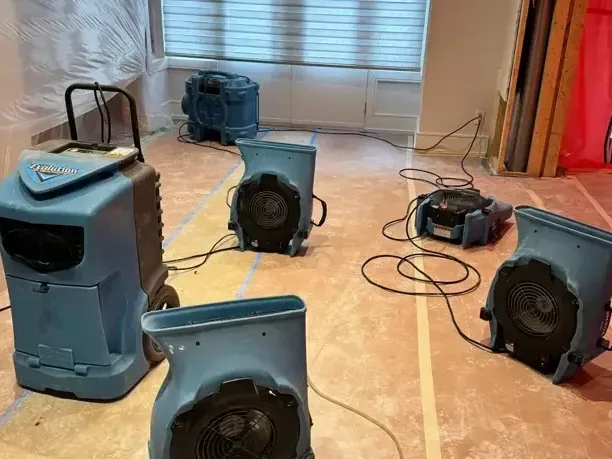
Structural drying removes the water that stays in framing, subfloor, plaster and concrete after extraction. The drying team sets air movers and LGR dehumidifiers by the class of loss and logs readings every day.
(888) 432-4933Book drying equipment for the wet framing IICRC S500 standard LGR dehumidifiers Daily readings
Why it works
Why the dry-out is measured, not guessed
Dispatch at any hour
The response team runs 24/7, and active water is treated as urgent on nights, weekends and holidays.
IICRC S500 drying standard
Moisture mapping comes first, then air movers and LGR dehumidifiers sized to the class of loss.
A claim file built as it happens
Timestamped photos before demolition, a moisture map and daily psychrometric logs go to the adjuster.
Built for cold-climate homes
Basements, sump pits, frozen pipes and ice dams lead the local list, so checks start below grade and at the eaves.
Do this first
What to do first for structural drying and dehumidification
Safe steps for the household while the response team is on the way.
- 1
Leave equipment running. Keep air movers and dehumidifiers on and plugged in.
- 2
Keep doors closed. Hold the dry air inside the drying area.
- 3
Hold heat steady. Keep the house at a normal temperature.
- 4
Do not refinish yet. Wait for dry readings before paint or flooring.
Cost and insurance
What does structural drying and dehumidification cost in Stillwater, MN?
Structural drying here usually runs $1,000 to $3,000 for one room, $3,000 to $7,500 for a basement or several rooms, and $7,500 to $18,000 when Class 4 materials like plaster or concrete need longer drying.
One room
$1,000 to $3,000
- Air movers
- Dehumidifier
- Daily readings
Basement or several rooms
$3,000 to $7,500
- LGR dehumidifiers
- Moisture mapping
- Psychrometric logs
Class 4 materials
$7,500 to $18,000
- Plaster or concrete
- Longer monitoring
- Specialty drying
Ranges are typical, not a quote: category of water, square footage, material class and how fast drying started move the number most. Run the water damage cost calculator for a closer range, and check your own policy for what it covers.
How it works
How structural drying and dehumidification is handled, step by step
1
Reference
Dry reading from an unaffected room.
2
Set up
Equipment sized to the class of loss.
3
Monitor
Daily readings and logs.
4
Release
Equipment leaves when readings say dry.
The full picture
Structural Drying and Dehumidification, explained
The class of loss sets the equipment
- Class 1: a small area, mostly low-porosity materials
- Class 2: a whole room with carpet and wall bottoms wet
- Class 3: water from above, walls soaked high
- Class 4: dense materials like hardwood, plaster or concrete
How readings decide when it is dry
On day one, the tech takes a reading from a dry part of the house as the reference. Wet materials are read every day and the equipment is moved as areas dry. It stays until each material is within 2 to 4 points of that reference.
Old plaster and basement concrete
Older homes near downtown often have plaster walls and block or stone foundations that dry slowly. Those get more dehumidification and longer monitoring, not more heat.
Why the logs matter
The daily psychrometric logs record temperature, humidity and moisture readings. They show the adjuster that drying was done to a standard and that the equipment days on the bill were needed.
Service area
Structural drying and dehumidification across Stillwater and the St. Croix Valley
The drying team covers ZIP 55082 and 55083, from the downtown riverfront and the older homes near Main Street out along Highway 36 and Highway 96 to the Manning Avenue border.
Nearby coverage reaches Lake Elmo, Hudson, WI, Mahtomedi, Oakdale, White Bear Lake, Oak Park Heights, Bayport, Houlton, WI.
Water still moving? (888) 432-4933
More
Related water damage services
FAQ
Structural Drying and Dehumidification questions in Stillwater, MN
Still wet right now?
Walls and floors still reading wet? The drying team sets up structural drying 24/7.
(888) 432-4933 (888) 432-4933Ask about the moisture readingsWhat is structural drying?
Structural drying removes the water held inside framing, subfloor, drywall, plaster and concrete after extraction, using air movers and dehumidifiers and daily readings.
How long does structural drying take?
Most losses dry in three to five days. Class 4 materials like hardwood, plaster and concrete can take a week or more.
Why does structural drying equipment stay after the room feels dry?
Surfaces dry before the materials inside them. The equipment stays until readings match the dry reference, not until the room feels dry.
What is an LGR dehumidifier in structural drying?
A low grain refrigerant dehumidifier pulls more water out of the air than a standard unit, which keeps evaporation going from wet materials.
Does structural drying follow a standard?
Yes. The IICRC S500 standard covers inspection, the class of loss, equipment, drying goals and daily monitoring.
24/7 emergency dispatch
Still damp under the surface? Dry it to a reading.
Water left in framing and concrete keeps causing damage after the floor looks dry. The drying team runs equipment until readings say dry.
(888) 432-4933Schedule the structural drying setup
Stillwater Water Damage Restoration
Stillwater, MN
(888) 432-4933
Open 24 / 7 / 365
Find us on Google