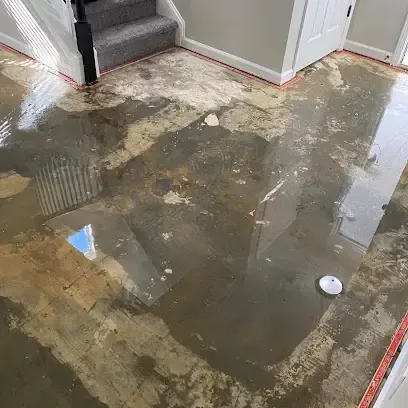
At a marina in Hudson, a metal pole at the end of a dock serves as a record of St. Croix River flood crests. The marks on it explain why owners near the river treat flood water as a serious cleanup and not a mopping job.
Key takeaways
- The uppermost mark on a marina's flood pole is April 27, 2001, and the 1965 crest was about two feet higher than the top of that pole.
- A 2011 Hudson Patch article, citing the National Weather Service, gives flood stage as starting at 687 feet, with the 1965 record at 694 feet.
- The 2001 flood destroyed the marina's two buildings and two rental properties, and the new facility opened in 2002.
- River water is handled as Category 3: standing water comes out first, porous materials are removed and the rest is cleaned and dried.
- Spring river level depends on snow, rain, temperature and the rate of melt, so a heavy winter is a reason to plan, not a prediction.
A river city with its flood history on a pole
Hudson is a river city on the St. Croix River, with bluffs running along the water. At a marina on the river, a metal pole at the end of a dock records flood crests.
The city was settled in 1840 at the mouth of the Willow River, and rivers have shaped its edges ever since.
The uppermost mark is April 27, 2001, about three quarters of the way up the pole. According to the marina's harbor master, the 1965 flood crest was about two feet higher than the top of the pole.
- 1965: the record, higher than the top of the pole
- April 27, 2001: the uppermost mark, three quarters of the way up
- 2002: the marina's new facility opened after the 2001 loss
What 687 feet and 694 feet mean
A 2011 Hudson Patch article, citing the National Weather Service, gives flood stage as starting at 687 feet, with the record set in 1965 at 694 feet. The record sits 7 feet above the level where flooding begins.
Flood stage is the point where a river starts to cause damage. It is a gauge number, not a property boundary, so the effect on any one home depends on where the home sits and how the water finds its way in.
April 2001: what a near-record flood destroyed
The near-record spring flood of 2001 destroyed the marina's two buildings and two rental properties, and the marina's new facility opened in 2002. Property at the water's edge can be a total loss.
Homes and businesses higher up the bank face a smaller version of the same problem: water in lower levels, soaked walls and a cleanup that cannot wait for the river to fall.
- Water usually enters through the lowest spaces first, such as basements, garages and ground floors
- Silt and debris arrive with the water and settle on floors and inside wall cavities
- Furnaces, water heaters and panels at low levels need a check before they are used again
- The river can stay high for some time, so drying cannot begin until the water leaves
Getting ready when the river is rising
A forecast rise on the St. Croix calls for preparation that is simple and cheap. Move belongings off the lowest floor, learn where the main electrical shutoff is and photograph the home while it is dry.
Photos of a dry house make a before-and-after comparison easy for an insurer. A short list of what is stored in low spaces does the same job for contents.
None of this holds the river back. It shortens the cleanup and makes the claim clearer.
- Lift furniture, boxes and appliances off the floor in low rooms
- Photograph every room and the outside of the house while it is dry
- Learn where the main electrical shutoff and the water shutoff are
- Keep important papers in a waterproof container on an upper level
- Read what the homeowner policy says about flood and water backup

Why river water is handled as Category 3
River water carries silt, runoff and sewage, so the industry treats it as Category 3, the most contaminated class. That moves the plan from drying everything to removing what cannot be made safe, and a flood water cleanup crew starts from that rule.
Because the contamination is in the water itself, cleaning is part of the job as well as drying. Surfaces that stay are washed and treated before they are dried, so that drying does not trap contamination inside the wall.
What is usually removed
Materials that soak up river water cannot be made safe again, so they are cut out and hauled away.
- Carpet, pad and underlayment
- Insulation and any drywall the water reached
- Particleboard, laminate and unsealed cabinet bases
- Mattresses, upholstery and stored cardboard
What is cleaned and dried
Framing, concrete, subfloor and solid wood can be washed, treated and dried. The drying team measures moisture in each material and continues until readings come within 2 to 4 points of a dry reference, which is the heart of structural drying.
Why the spring level is hard to call
According to the harbor master, the spring river level depends on how much snow and rain falls, the temperature and the rate of melt. A heavy winter does not mean a flood is certain, and a mild one does not rule one out.
A University of Wisconsin-Madison Libraries digital record titled Hudson flooding describes homes threatened by flooding along the St. Croix River. That shows the concern reaches homes, not only docks.
After the water: extraction, drying and records
Once the river is down, the order of work is water extraction, removal of damaged materials, cleaning and drying. Records matter at every step.
- Photograph the waterline on walls and furniture before anything is moved
- Leave a flooded furnace, water heater or outlet off until it has been checked
- Keep the daily moisture readings for the insurance file
- Ask the insurer whether flood coverage is separate from the homeowner policy
Questions
Does flood stage mean water is inside a house?
No. Flood stage is a river level, and whether water reaches a given home depends on where the home sits and how water enters. The effects start in the lowest spaces.
Why is river water treated differently from a burst pipe?
A burst pipe starts with clean supply water, while river water carries silt, runoff and sewage. That is why it is handled as Category 3 from the start.
Can a flooded basement be dried without removing anything?
Rarely. Porous materials such as carpet pad, insulation and drywall that river water reached are usually removed, while framing and concrete are cleaned and dried.
What should be photographed first?
The waterline on walls, furniture and appliances, then each room before anything is moved. Photos taken before cleanup begins carry the most weight for a claim.
Is flood damage covered by a standard homeowner policy?
Coverage varies, and flood is often written as a separate policy. The insurer can say what applies to a given home.
How long does a river flood cleanup take?
It depends on how high the water rose and how long it stayed. Extraction and removal come first, and drying then continues until readings reach the dry reference, which can take several days.